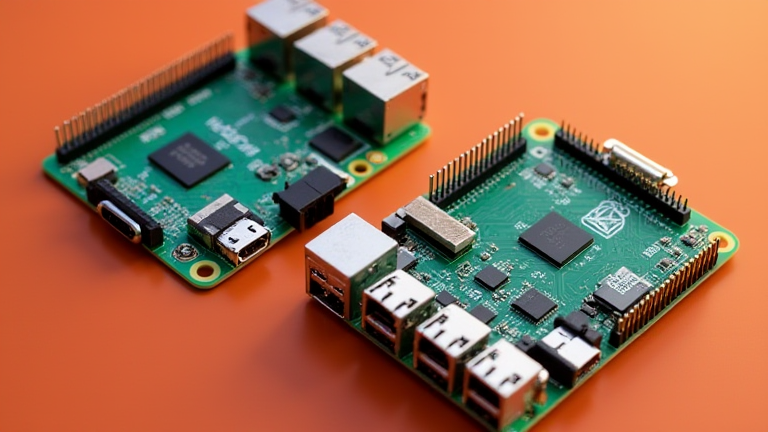
TL;DR: The Raspberry Pi 5 wins for home automation due to its superior software ecosystem, extensive community support, and seamless integration with major platforms like Home Assistant. The Orange Pi 5 offers better raw hardware value but lacks the plug-and-play simplicity and long-term reliability of the Raspberry Pi.
The Current Landscape
The single-board computer (SBC) market has become increasingly competitive, with Chinese manufacturers like Allwinner challenging the dominance of Raspberry Pi. For home automation enthusiasts, the choice between the Raspberry Pi 5 and the Orange Pi 5 is critical, as these devices often serve as the central brain for smart homes. While both boards offer impressive performance for their price points, their value propositions diverge significantly when applied to the specific demands of 24/7 home monitoring and control systems.
If you want to dig deeper, check out our guide on JAXA Launches Mars Moon Mission Oct. 20.
Hardware Specifications and Performance
On paper, the Orange Pi 5 presents a formidable challenger. Equipped with the Rockchip RK3588S processor, it delivers multicore performance that rivals or exceeds the Broadcom BCM2712 chip found in the Raspberry Pi 5. The Orange Pi 5 typically comes with more RAM options, including 8GB and 16GB configurations, which is advantageous for running heavy-duty container stacks or local AI models. However, the Raspberry Pi 5 compensates with its refined power management and efficient heat dissipation, crucial for devices running continuously in closets or server racks. The Pi 5’s improved GPU and dedicated PCIe 2.0 interface also provide stable connectivity for NVMe storage, which is essential for logging extensive sensor data without lag.
Software Ecosystem and Industry Impact
The primary differentiator in home automation is software support. The Raspberry Pi Foundation has cultivated an unmatched ecosystem. Almost every major home automation platform, including Home Assistant, HomeKit, and various IoT frameworks, provides native, optimized images for the Raspberry Pi 5. This ensures that users receive timely security patches, driver updates, and stable kernel support. In contrast, the Orange Pi 5, while supported by Linux distributions, often lags behind in driver maturity for specific peripherals like USB Wi-Fi adapters and temperature sensors. The industry impact is clear: enterprises and large-scale integrators prefer the Raspberry Pi due to its predictability and long-term availability guarantees, reducing the risk of supply chain disruptions that have plagued other SBC brands in recent years.
Conclusion
While the Orange Pi 5 is a powerful tool for developers who enjoy compiling kernels and customizing drivers, the Raspberry Pi 5 remains the superior choice for most home automation projects. Its balance of performance, software stability, and community resources ensures a smoother user experience. For those prioritizing raw computing power over ease of use, the Orange Pi 5 is a viable alternative, but for reliable, set-and-forget home systems, the Raspberry Pi 5 is the clear winner.
FAQ
Q: Which board is better for running local AI models?
A: The Orange Pi 5 is generally better for local AI due to its more powerful NPU and higher available RAM configurations, though it requires more manual optimization.
Q: Are there significant power consumption differences?
A: Yes, the Raspberry Pi 5 is more power-efficient under load, making it ideal for always-on devices where energy costs and heat generation are concerns.
Q: Can I use the same case for both boards?
A: No, the physical dimensions and mounting hole patterns differ between the Raspberry Pi 5 and Orange Pi 5, requiring specific cases for each model.
Leave a Reply