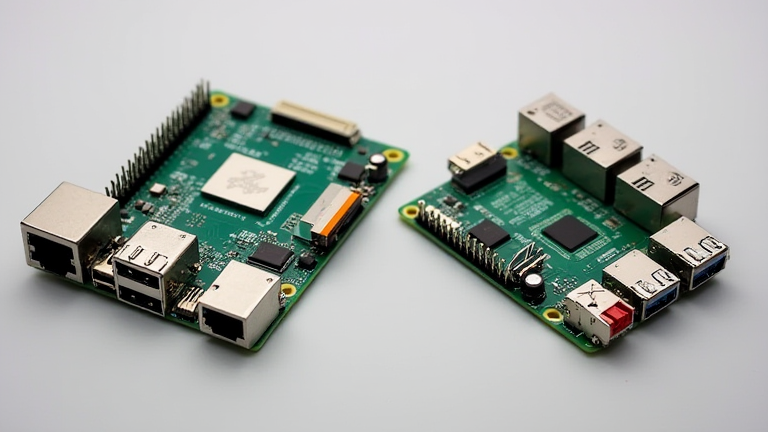
TL;DR: The Raspberry Pi 5 delivers roughly 2–3x the CPU and GPU performance of the Pi 4, with faster I/O and PCIe support, but draws more power and costs $5 more. For most desktop and AI workloads, the Pi 5 is the clear upgrade; for low-power embedded tasks, the Pi 4 remains a solid budget choice.
Performance Leap: From BCM2711 to BCM2712
The Raspberry Pi 5 swaps the Pi 4’s quad-core Cortex-A72 (BCM2711) for a quad-core Cortex-A76 (BCM2712) running at 2.4 GHz. This architectural jump brings a 2–3x improvement in multi-threaded tasks, with Geekbench scores roughly tripling. The new VideoCore VII GPU adds Vulkan 1.2 support and hardware AV1 decode, making the Pi 5 a viable 4K media center. Memory bandwidth also doubles to LPDDR4X-4267, which reduces bottlenecks in memory-hungry Python and machine-learning scripts.
If you want to dig deeper, check out our guide on Why the Razer BlackWidow V4 Is the Best Mechanical Keyboard .
Power and Thermal Dynamics
The Pi 5’s increased performance comes at a cost: idle power consumption rises from ~2.7W (Pi 4) to ~3.6W, and under load it can hit 10–12W vs. the Pi 4’s 6–7W. The new 28nm process is more efficient per clock, but the higher frequency and faster I/O demand more juice. Critically, the Pi 5 requires a 5V/5A USB-C power supply (or 5V/3A with a current limiter disabled) and ships with an active cooler in the official kit—passive cooling is insufficient for sustained loads. The Pi 4 remains passively coolable at lower clocks.
Connectivity and Industrial Impact
The Pi 5 introduces a PCIe 2.0 x1 interface (via FPC connector) for NVMe SSDs, a feature long demanded by industrial users. This, combined with dual 4K HDMI outputs, USB 3.0 (now full-speed at 5Gbps), and a new RP1 I/O controller, positions the Pi 5 as a drop-in replacement for edge AI boxes and network appliances. The Pi 4’s USB 2.0 bottlenecks are gone, enabling faster data logging and camera pipelines. However, the Pi 5 drops the 3.5mm audio jack (moved to USB/HDMI), and its higher power draw complicates battery-powered deployments. Industry analysts see the Pi 5 pushing the SBC market toward real-time inference and NAS roles, while the Pi 4—now cheaper on the secondary market—remains the go-to for education and kiosks.
Price and Value
At launch, the Pi 5 (4GB) costs $60 and the 8GB version $80, vs. the Pi 4’s $35 (1GB) and $55 (4GB). The $5 premium over the equivalent Pi 4 4GB is justified by the performance and PCIe, but you must budget $10+ for an active cooler and a 5V/5A PSU. For hobbyists who already own Pi 4 accessories, the upgrade cost is higher. For new builds, the Pi 5 is unequivocally better value per dollar of compute.
FAQ
Q: Can I use my Raspberry Pi 4 power supply with the Pi 5?
A: Only if it’s a 5V/3A USB-C with a 5A-capable cable and you disable the USB current limiter via config.txt—but this risks instability under load. Officially, a 5V/5A PSU is required.
Q: Is the Raspberry Pi 5 backward compatible with Pi 4 cases and HATs?
A: Mounting holes and 40-pin GPIO are identical, but the USB port positions, power button, and MIPI connector layout differ. Most
Leave a Reply